Sunday, June 8, 2008

Homeschooling Labeled 'Anarchy' in Cali

Jeff Johnson - OneNewsNow - 6/5/2008
schoolwork bigThe response of California's teachers' union to pro-family attempts to protect home schooling in that state has outraged one attorney who is working on the case.
Numerous organizations on both sides of the issue have filed friend-of-the-court briefs in the appeal of a California court's ruling that parents have no right to home school their children. But one reaction in particular caught the attention of pro-family attorney Brad Dacus, president of the Pacific Justice Institute.

"The California Teachers Association ... decided to file an amicus brief arguing before the court that parents should have no right over the education of their children, should not have a right to home school, and that these children should be literally forced to be put back into the public schools -- even though parents object," the attorney explains.

Dacus did a double-take when he read one specific charge made by the teachers' union. "In their brief, the teachers' union said that to allow parents to be able to home school without being credentialed teachers could result in 'educational anarchy,'" he shares.

That argument, he says, discounts reality. "This is ignoring the facts that home schooling is widespread in California," he exclaims. "Over 200,000 children are being home schooled right now in California -- and they score higher academically than not only public school children, but also children in traditional private schools. If there's anarchy, the anarchy is in public schools."

Both the state superintendent of public instruction and the California Department of Education have filed briefs supporting the legality of home schooling. A brief filed by Governor Arnold Schwarzenegger and Attorney General Jerry Brown argues that home schooling is perfectly legal under California law and states that the practice "has a long and positive history in California and across the nation." The California Court of Appeal intends to hear oral arguments in the case sometime this month.

Saturday, June 7, 2008

Bella: the Movie


Bella is the winner of the 2006 People's Choice Award at the Toronto International Film Festival, and is refreshing in it's story and acting. This movie isn't about action and adventure, but it's a movie about life. Everyday life, and how two people cope with theirs. Part of what makes the movie so enjoyable for me is the acting feels real. When watching the movie I wasn't struck with the fake feel I get from so many typical Hollywood movies. This movie feels genuine, the tears and laughter seem real instead of put on to make money. I think a large part of that has to do with the case selected for this movie. They actually believe in the story and it's message, and aren't concerned solely about the money making aspect of the film. That makes this movie all the more real and powerful.

The movie is rated PG-13 (for thematic elements and brief disturbing images) largely for one scene. Most mature children probably 8 or 9 and up should be able to watch the movie and handle it well.

Bella has won several awards in addition to the People's Choice. Along with other accolades Edward James Olmos chose this movie to open the LA International Film Festival. At that time he said, "It is one of the most impressive landmark films to open our festival in 10 years ... a film people have to see, it really captures the heart and makes you think. It is one of the best films to come out in a long time." (emphasis mine)

I certainly agree, and highly recommend this movie. I hope to add Bella to my movie collection very shortly.

3 out of 5 stars.

Official Movie Site


This post does contain affiliate links; thank you for your support.

Monday, May 26, 2008

Just a Thought

We don't see things as they are, we see things as we are.
(- Anais Nin)

Sunday, May 25, 2008

Rubik Cube

Not fair! I wish I could just solve one of these things. *sigh* This little three year old probably doesn't even realize how hard it's supposed to be to do this feat.


Wednesday, May 21, 2008

Dear Kilt Wearers

Dear Kilt Wearers,

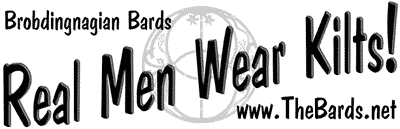
Yesterday, on my way home from a used bookstore (one of my favorite places) I saw a bumper sticker that intruiged me. It said:Naturally, this brought to mind other "real men" claims such as "real men cry" (or don't cry, depending on who you ask), "real men wear pink," "real men wear purple" and any other "real men" claim you of which you can think.

What do these claims imply? Surely not all "real men" do these things, and surely there are some who cry not, wear pink, etc, who are not "real men" (whatever does that phrase mean anyway?).
And do these claims further imply that if anyone wears a kilt or cries or wears pink that they are a "real man?" I know plenty of women who do these things (well, I don't know many who wear kilts).

Obviously if you have Scottish ancestry you oughtn't be ashamed of it, but why would anyone otherwise have cause to wear a kilt? And even if you are part Scottish what would it accomplish to do such a thing?

All of these wonderings from one little bumper sticker. What are your thoughts, kilt wearers? readers?

Curious,
Sophie

Tuesday, May 20, 2008

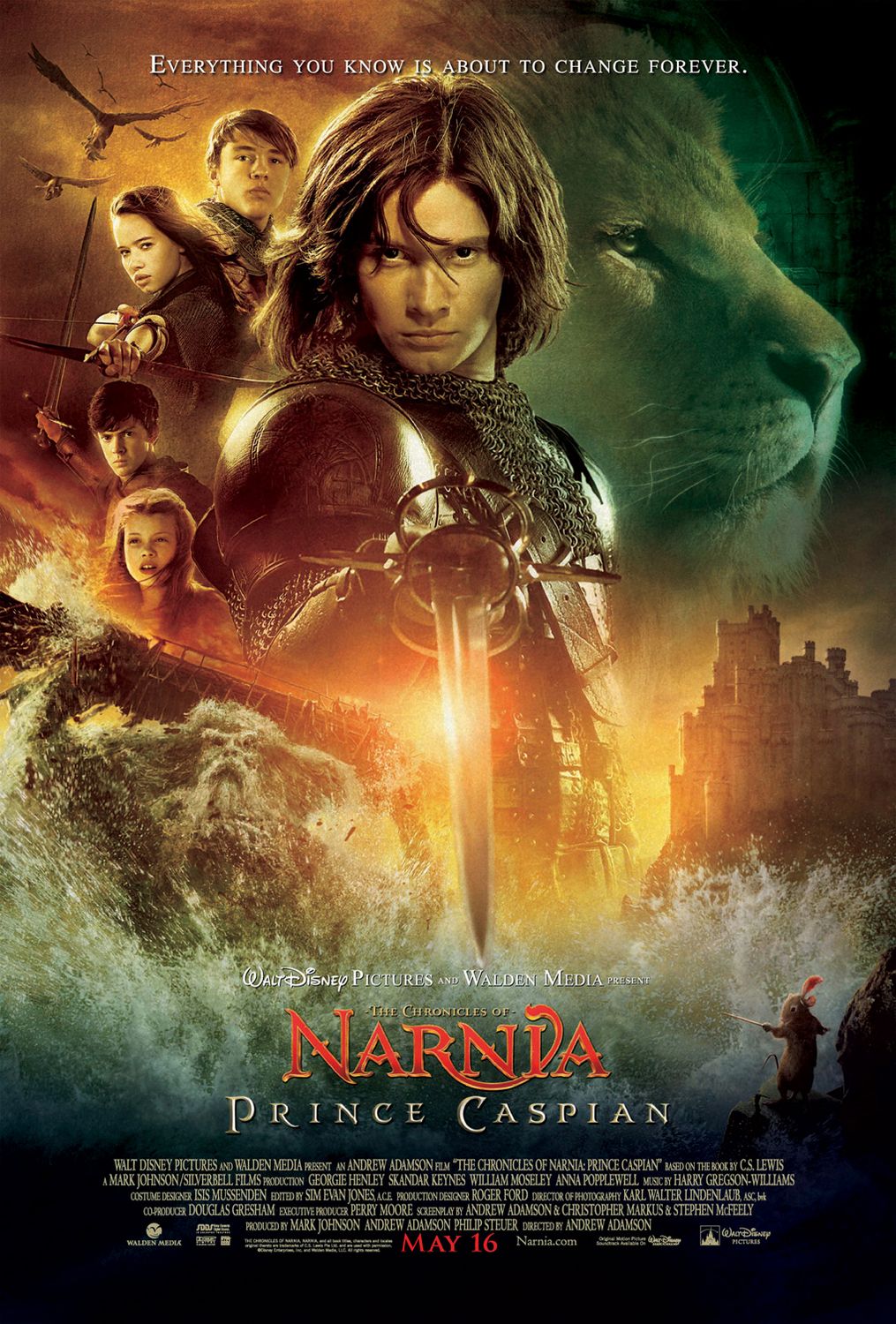
Prince Caspian {Movie Review}


Yes, a new age has begun in Narnia, but the focus of this newest rendition of the classic Narnian tale "Prince Caspian" falls short of the mark the book left for it to reach.

SPOILERS AHEAD


With continuous comments such as
Lucy: "I was so tall"
Susan: "You were older back then"

and
Peter: "I wasn't always a child"

the movie would have more aptly been title Back When We Were Grownups but, since that title is already taken, perhaps Remember When We Were Grownups would also suffice.
There are obviously certain items that must be changed in any translation. There are some forgivable translation "errors" and some unforgivable ones. This movie is riddled with both.

I understand why they had to begin the movie in the fashion they did (though they could have made it harder for the Pevensie's to figure out they were in the ruins of Cair Paravel), but seriously, must Peter be portrayed in such a high-and-mighty fashion?

Peter (to Trumpkin): "High King Peter, (pause) the Magnificent"
Susan: "I think you could've left the last part off"


So, I do understand why they would cause such an adjustment in Peter, but that causes focus to shift from what Lewis emphasized in his work, and completely adds an unnecessary dimension to the story. But I can understand their rationale.

But must Susan and Caspian "fall in love?" I was seriously hoping they would not add that in the movie (not to mention it could cause for a sticky situation in Dawn Treader). I mean COME ON, really. Again, it totally detracts from Lewis' work (and the kiss was even more unnecessary than their feelings for each other).

Susan: "Why don't you hold on to it [her horn]. You might need to call me again."

...
Susan: "It never would've worked, anyway."
Caspian: "Why not?"
Susan: "I am 1300 years older than you..."


Adding the White Witch definitely added conflict to Disney's version, but utterly went against Lewis' intentions. Lucy was still herself, Reepicheep rocks, and Edmund's character came across nicely (in fact, him and Peter seemed to have swapped places from The Lion, The Witch, and The Wardrobe, which shouldn't be the case AT ALL, but ...), but Aslan played a terribly small part in the movie when he permeates the book.

I did (thankfully) know going into the movie that it did not stick to the book. The article (in World magazine) that I read said that most fans would be pleased with the movie rendition, and that only the die-heart purists would be disappointed. That would be me.

So, I said that Prince Caspian was a "Must See Movie" do I know have cause to eat my words? Yes and no. In spite of all of the problems in adaptation that I pointed out (which only scratch the surface of some interpretive issues) I actually really did enjoy the movie (in spite of the stupid "romance" which detracts, even if separating from the film from the book), as long I did not at all compare it to the book. As a movie not based off of a novel it was pretty good. But, like almost every movie adaptation, it misses the mark ... big time when compared to the actual novel. However, great lessons can be learned from this latest edition of Prince Caspian. You may not want to take your small children to go see this movie even if they were okay with the first movie (this movie has more violence and "fantastic" [in the classical sense of the word] creatures), but Caspian is worth seeing.


1.5 out of 5 stars.

This post does contain affiliate links; thank you for your support.

Saturday, May 17, 2008

'CRIME AND ETHANOL': Unintended Consequences

This is a follow-up article from this post.
Crime and Ethanol: Unintended Consequences
By Chuck Colson


Biofuels are one of the major reasons you and I are paying more for groceries these days. For most of us, it is just an inconvenience. For many around the world, however, it is a catastrophe. Last week, United Nations Special Investigator Jean Ziegler called the use of biofuels, such as ethanol, a "crime against a great part of humanity."

In the past, global food crises were sparked by natural disasters and bad harvests. What makes this food crisis a crime against humanity is: We caused it. And like many man-made problems, this one can be traced to our false worldview.

Here in the United States, egg prices are up 35 percent; milk up 23 percent; and bread up 16. For most Americans, who on average spend 10 percent of their income on food, these increases squeeze our budgets.

But for the "great part of humanity" Ziegler talks about, it is a lot worse. In countries like Ethiopia and Bangladesh, people can spend 70 percent of their income on food; so even modest increases in food prices can impair their ability to feed their families. And price increases for the staples they depend on have not been modest: Wheat prices have doubled and corn prices quadrupled in the last year.

Rising food prices are causing social instability. According to the World Food Program, "33 countries in Asia and Africa face political instability as the urban poor struggle to feed their families"-which is why the president and Congress are talking now about increasing aid to these countries.

While the rise in food-staple prices has many causes, as Ziegler noted, one of them is definitely man-made: the use of cropland and food-staples to produce bio-fuels such as ethanol. He called "transforming hundreds and hundreds of thousands of tons" of foodstuffs into fuel "absolutely catastrophic for the hungry people."

Look at it this way: It takes 510 pounds of corn to make 13 gallons of ethanol-that amount could "feed a child in Zambia or Mexico for a year," while it fuels your car only for a week!

Ziegler is not alone; the IMF (International Monetary Fund) has raised grave concerns, and Secretary of State Rice recently spoke of the "unintended consequence from the alternative fuels' effort."

What is maddening about this is that the biofuel effort is fueled by politicians handing out massive subsidies to the farm belt and pandering to glassy-eyed environmentalists. Every presidential hopeful who participated in the Iowa caucuses had to sing the praises of ethanol. That is why John McCain stayed away, because he opposes the subsidies.

Now, I am all for farmers making money on their crops. They deserve it. But no politician with a shred of integrity can deny that it is more important to feed a child in Zambia for a year than to feed your car for a week. And-as if I need to remind you-this is an election year, so ask your candidates where they stand on this tragic political folly. And call your members of Congress to tell them how you feel.

A properly informed worldview is the key here. Two non-Christian worldviews have merged to bring about this crisis: one that sees maintaining political power as an end in itself, and one that sees the environment as our chief concern, even at the expense of humans.

We Christians insist on the proper use of government: that is, to restrain evil and promote justice. And we believe in proper environmental stewardship. But we insist that people, especially the poor, must come first.

from Breakpoint's May 7, 2008 newsletter